

Blog
Diving in Palau: To the Far Side of the World and Back

Some places stay with you from the first photograph. You see them and think: one day. Diving in Palau was that dream for us. A blue-green dot in the middle of the Pacific Ocean, it seemed almost as distant as the moon. Then we decided to stop dreaming and go.
We made the trip in 2019, just before the world came to a halt. The routes, services, site access and conditions described here reflect that visit. Before the pandemic, before wars became daily headlines, long journeys still felt wonderfully ordinary. We flew through Moscow, then spent what felt like endless hours above an endless sea. At every connection, we wondered whether an island with water that colour could really exist. Part of us still hopes to return to those simpler days, when the world felt open, peaceful and full of possibility.
Our arrival in Palau began with a wall of humidity. Stepping off the plane at the small airport before dawn, we felt the heavy air first. Then came the scent of salt, and with it the unmistakable feeling that our holiday had begun.
Our trip was planned and supported by Wild Dive — specialists in diving holidays around the world. They turned Palau from a dream into a journey, with personal support, boat trips and local dive-centre connections that kept each day running smoothly.
Contents
- The Long Journey to Palau
- Small Islands in a Vast Ocean
- Days of Diving in Palau
- A Day on Land: Buggies, Nature and Open Space
- Taking Palau Home
The Long Journey to Palau
Our journey to go diving in Palau began in Israel and took almost a full day: around 24 hours of flights, transfers, security checks, curious airline meals and attempts to sleep in impossible positions. In 2019, flights through Moscowwere still an option, and that was our route. We spent several hours in a vast airport filled with the scents of tea and alcohol, and travellers from around the world.
We had no idea how much was about to change. Just months after our Palau trip, a new virus began to spread: coronavirus. In 2020, travel came to a halt across much of the world. Borders closed, planes were grounded and diving trips were postponed indefinitely. Later, war between Russia and Ukraine shook Europe, and Moscow became an airport far fewer travellers passed through.
Small Islands in a Vast Ocean
Palau is an archipelago of more than 300 green islands in the Pacific Ocean, between the Philippines and Guam. Forest-covered rock islands rise from clear turquoise water, with visibility stretching tens of metres and coral reefs that look almost painted.
Traffic drives on the right, as it does in Israel, but many cars are second-hand imports from Japan with right-hand steering. It takes a little getting used to. Soon, though, the roads draw all your attention: narrow strips of tarmac stretching over the sea between green islands.
On our first day, we met the team at Fish and Fins — a warm Israeli team whose dive centre made diving in Palau a pleasure. Everything was well organised, the equipment was excellent, and the service felt personal and friendly. There was a welcome bonus, too: what we thought was the best coffee on the islands.
We stayed at Palau Hotel — a pleasant, clean and centrally located hotel in Koror. Friendly staff, comfortable rooms and tropical views made it an inviting place to rest after long days of diving and plan the next day’s adventures.
Days of Diving in Palau
Entering caves or wreck interiors requires appropriate overhead training, equipment and gas planning.
Palau works its magic underwater. The water was around 28-30 degrees, visibility on good days reached beyond 25 metres, and the currents brought the scene to life. Inside the lagoon, dives were gentle, with passages, crevices, small fish and marine plants. On the outer reefs, dramatic walls and strong currents brought encounters with sharks, tuna and manta rays.

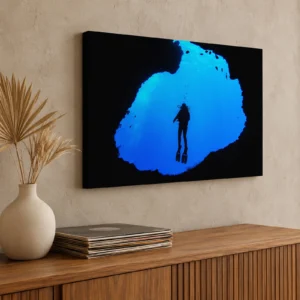
A diver in the blue hole. Bring this photograph home: shop the print
Blue Holes
Our diving marathon began with an early dive at Blue Holes. We descended through four small openings in the reef into a vast cavern. Sunlight streamed through the vaulted spaces in brilliant blue beams. From the exit, we reached the outer wall, which leads towards Blue Corner when the current is right.

(Blue Holes from the air. Drone photograph: Boaz Samorai)
Blue Corner
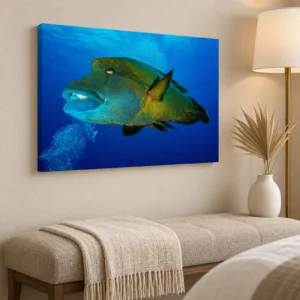
Blue Corner is one of the world’s best-known dives. We entered along the outer wall and used a reef hook to hold position in the strong current. That is part of our trip account; divers should follow site rules and avoid contact with living coral. Grey reef sharks, barracuda and curious Napoleon wrasse moved around us. It felt like stepping into a wildlife documentary, with the ocean at full power.

A curious Napoleon wrasse at Blue Corner. Find an original print for your home or office: shop the photograph
Helmet Wreck
At night, we descended to Helmet Wreck, a small ship in Malakal Bay at about 28 metres. Our torch beams revealed helmets on the deck, open ammunition boxes and rusting nets. In the darkness, the wreck felt dreamlike. It was one of the trip’s most memorable dives.

Jake Seaplane
A relaxed daytime dive took us to an almost intact Japanese aircraft at about 12 metres. Glassfish, clownfish and delicate corals surrounded the wreck. With excellent visibility and little current, it was a rewarding site for underwater photography.

Peleliu
This challenging site in southern Palau brings strong currents and large animals: sharks, tuna and sometimes manta rays. The current demands experience and control, but the reward is a glimpse of Palau at its wildest and most alive.

This clownfish photograph is also available as a canvas print in a range of sizes: explore the print
Chandelier Cave
Chandelier Cave is one of Palau’s best-known and most intriguing dives. Connected chambers contain stalactites that resemble chandeliers, giving the cave its name. Dive lights reveal the formations inside.

Jellyfish Lake
Jellyfish Lake is an extraordinary place. Reaching it means climbing hundreds of steps through dense jungle to a lake tucked among the rocks. The golden jellyfish have stinging cells, although their stings are usually mild for swimmers. Their numbers vary greatly with conditions. Floating among them during our visit felt like entering another world.

A Day on Land: Buggies, Nature and Open Space
After five consecutive days of diving, we spent our final day on land before the flight. For divers without symptoms after multiple days of no-decompression diving, DAN recommends at least 18 hours between the last dive and flying. Dives requiring decompression stops call for substantially longer, and longer intervals reduce risk further. In the morning heat and humidity, we climbed into RZR buggies and followed a trail through jungle, beaches and shallow water crossings. Vivid greens, tropical birds and glasses fogging in seconds made the whole drive feel like a journey through a nature film.
By the time we returned to the hotel, the sun had set. We changed, shook off the dust and settled down with a local beer. The day felt complete: a calm, smiling farewell to the ocean.

Taking Palau Home
When we think about diving in Palau, we remember far more than a holiday. We remember a place where the sea felt whole, the quiet ran deep, and people lived close to the natural world. Palau taught us to slow down, notice more and feel connected to the land and water.
For us, it was a dream fulfilled. Every day brought a discovery, every dive opened another world, and every evening ended in a little more peace. Photographs can capture a place beautifully, but among Palau’s sharks and jellyfish we realised how much richer the colours are in person.
If you are dreaming of a diving trip to Palau that feels adventurous and stays with you, put these islands high on your list. The experience reaches well beyond the dives themselves.
Thank you to Wild Dive for planning the journey, to the team at Fish and Fins for making us feel at home on the water, and to the people of Palau for the warmth of their welcome.
See you on the next dive.
More stories and photographs from our diving trips to Palau are waiting on our blog, where you can also find your way to original underwater photographs from the journey.
Explore our canvas prints
Underwater Photography
Underwater Photography


Underwater Photography


Underwater Photography