

Underwater, Blog, Wildlife
Coral Reef Partnerships: Life Beneath the Surface

Corals and sea anemones belong to the class Anthozoa. Its Greek name, “flower animals,” evokes their extraordinary colors and forms. Even the finest garden blooms have competition beneath the sea.
Dive or snorkel over a coral reef and you enter a world crowded with life. Many reef-building corals thrive in clear, nutrient-poor water with help from algae living in their tissues. They build a habitat for a rich community of marine life.
Their success depends on intricate partnerships with other reef life. Viewed as a whole, the reef can seem like a single organism, its inhabitants connected by countless relationships. Those connections also make it vulnerable. Disturb the balance and the loss of one animal can put the wider reef at risk.
A reef grows slowly. Reef-building corals produce limestone skeletons, but their growth rates vary with species and conditions. Branching corals can grow much faster than massive corals.
A coral colony can begin when a free-swimming larva, called a planula, settles on a suitable surface and develops into a polyp. The colony then grows as polyps multiply.
Many reef-building corals host photosynthetic algae within their tissues. The algae supply nutrients and contribute to the coral’s color. The coral provides shelter and materials the algae use for photosynthesis. Coral polyps also catch plankton and other prey with their tentacles.
Other corals arrive as hitchhikers, settling on the surfaces already created and starting colonies of their own. Each new colony adds more space for life to take hold.
Small invertebrates move in among the branches: crabs, shrimp, worms and nudibranchs, all finding shelter in the coral.
Each develops close ties with its surroundings. Some crabs shelter among the stinging branches of Acropora coral. In return, they clean their immobile host and eat the parasites that threaten it. In this kind of symbiosis, both partners benefit.

Small damselfish gather among the corals. At the first sign of danger, they dart into the reef and wait for a larger fish, a hungry eel or a passing shark to move on. These small fish feed on tiny invertebrates, drifting clouds of plankton and even parasites that trouble larger fish.
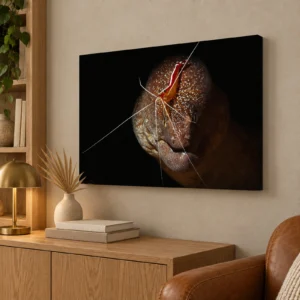
The reef’s relationships reveal a community that helps sustain itself. Cleaner wrasses feed on parasites from much larger fish, including giant moray eels and groupers that might otherwise eat them. At a cleaning station, these clients wait patiently and open their mouths, letting the little cleaner pick out food lodged between their teeth.
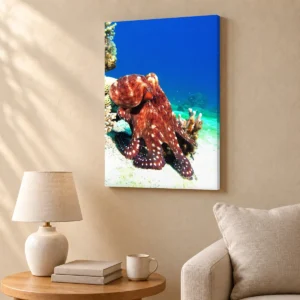
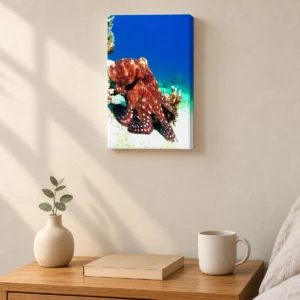
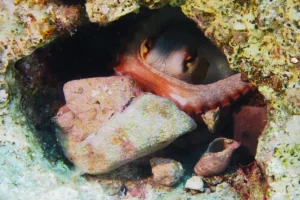
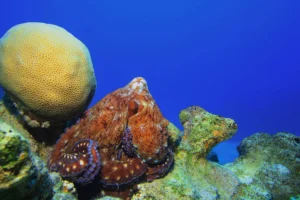
Larger fish eat smaller ones, and the reef’s circle of predators expands. Triggerfish and pufferfish join the community that feeds around the coral. An octopus may arrive, spreading its hunting arms to catch small fish before they can escape.
Reef fish reproduce in different ways. Some release eggs into the water; others, including many damselfish, attach eggs to a surface and guard them.

Anemonefish make their homes in sea anemones, distant relatives of corals. They feed their host, protect it from predators and boldly drive away fish far larger than themselves. Beneath the anemone, hundreds of tiny red eggs cling to a small rock. This next generation is guarded by its parents and their stinging companion.
The anemone shelters a wider community, too. Transparent shrimp hover above it. Crabs hide among its stinging tentacles and clean away leftover food.

In the reef’s shade, a watchman goby stands guard. Its head peers out while its tail remains inside a neatly dug sandy burrow, reinforced with small stones to keep it from collapsing. Watch patiently and you may spot a shrimp keeping an antenna in contact with the goby. The pair share a remarkable arrangement: the fish keeps watch and catches food while the shrimp digs and maintains their home.
Through a complex system of signals, the goby tells the shrimp when it is safe to venture out and when approaching danger means it is time to retreat.
Partnerships take countless forms on a coral reef. Some crabs attach a small anemone to their backs for protection from predators. Fish protect one another by day and night. This colorful, interconnected world begins with a single small coral.
Explore our canvas prints

Underwater Photography
Underwater Photography

Underwater Photography
Underwater Photography